

STI Information Hub
Learning about STIs and their impact is a powerful step toward protecting your health and your community. Explore the sections below to learn more about HIV, syphilis, and hepatitis C.
What are Sexually Transmitted Infections?
Sexually Transmitted Infections (STIs) are infections caused by viruses, bacteria, fungi, or parasites that are most often spread through sexual contact, including vaginal, anal, and oral sex. Some STIs can also be spread through skin-to-skin contact, bodily fluids (such as blood, semen, or vaginal fluids), or from a parent to a baby during pregnancy or birth.
You may also hear the term STD (sexually transmitted disease). People often use STI and STD to mean the same thing. An STI may be called an STD if it begins to cause symptoms or other health problems.
Many STIs do not cause symptoms right away, so a person may not know they have one. The only way to know for sure if you have an STI is to get tested. Without testing and treatment, some STIs can lead to serious health problems over time. The good news is that many STIs can be prevented, treated, or managed with the right care and medicine.
Let’s go into the specifics!
Understanding the basics is important, but each STI has its own symptoms, transmission, and treatments.
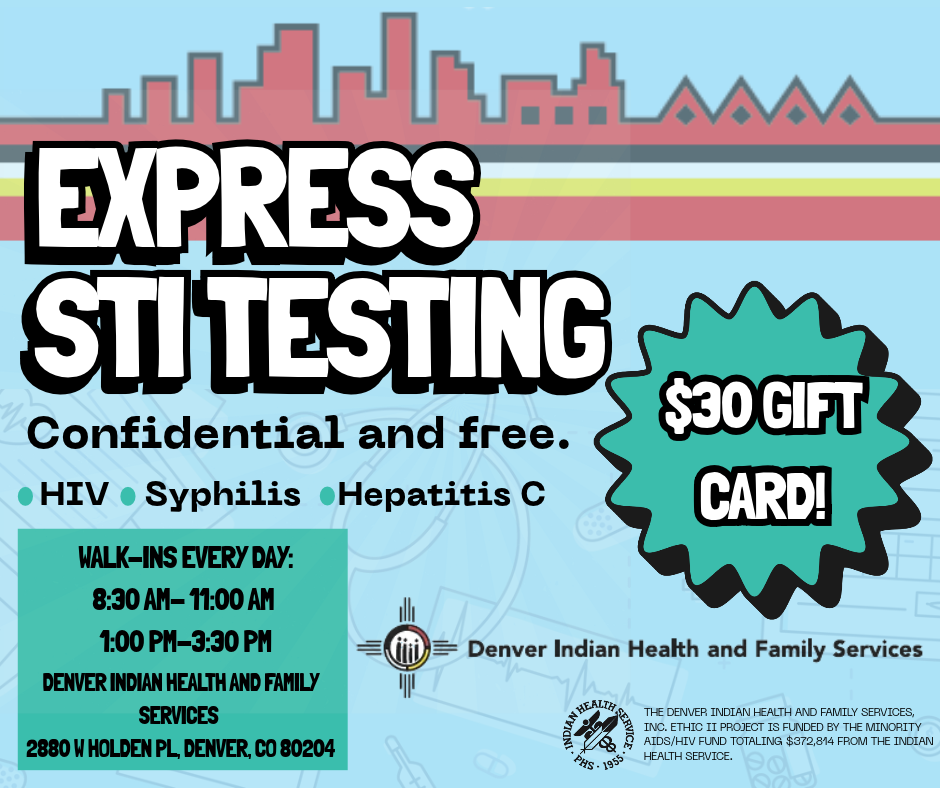
Express STI Testing
We offer Express STI Testing every day!
When? 8:30 AM – 11:00 AM and 1:00 PM – 3:30 PM
Where? 2800 W Holden Place, Denver, CO 80204
Express STI testing is free of charge and open to anyone 13 years and older. You do not need to be a registered DIHFS patient to participate.
This service is different from our regular walk‑in clinics and results can take up to one hour.
As a limited-time offer, participants can receive a $30 gift card when they return to receive their test results.
STIs and American Indian and Alaska Native communities
-
American Indian and Alaska Native (AI/AN) people are affected by STIs at higher rates than some other groups. This affects Native communities in both cities and rural areas.
-
Native communities are affected by STIs more than other groups. This is not because of choices people make. Many people face challenges that can make it harder to get health care, testing, and treatment.
Making services easier to get and providing welcoming, respectful care can help Native individuals, families, and communities stay healthy.
-
Many STIs do not cause symptoms right away. This means people may not know they have an STI unless they get tested.
When people cannot get testing or treatment, infections can go untreated and lead to more serious health problems.
These challenges can affect Native people, families, and communities. They can also affect future generations when infections are not found and treated early.
Health information shows that Native people get HIV, syphilis, and hepatitis C more often than some other groups. This is why testing and treatment are so important.
To learn more: https://www.cdc.gov/health-disparities-hiv-std-tb-hepatitis/populations/american-indian-alaska-native.html